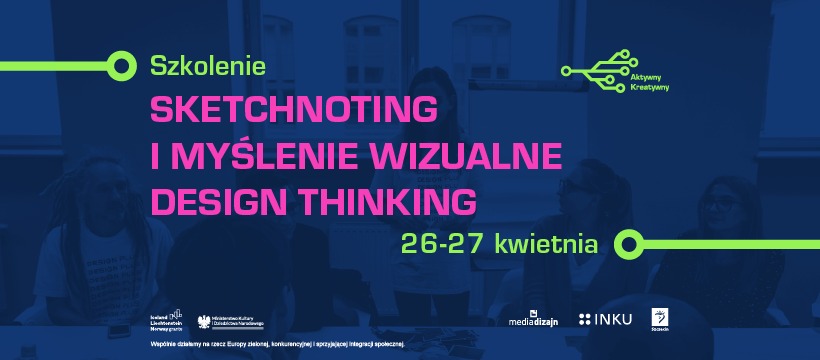
We warmly invite you to participate in the free training session entitled ‘Sketchnoting and Visual Thinking’ as well as ‘Design Thinking in Practice’.
The Design Thinking training will take place on April 26th from 12:00 to 20:00, while the Sketchnoting training will take place on April 27th from 10:00 to 18:00 at INKU Creative Sectors Incubator. Our instructors are Ania Staśkiewicz and Jakub Cichocki. Additionally, online meetings totaling 4 hours will be organized, which will be scheduled jointly with the instructors and participants of the training. Upon completion of the training, each participant will receive a certificate.
“Sketchnoting and Visual Thinking” is a training session perfect for those who want to learn how to create visual notes from scratch. We invite you to an exciting training that will open up new possibilities for teamwork and creative thinking! The training focuses on developing visual thinking skills and utilizing notes as a powerful tool in teamwork.
Would you like to discover how you can effectively communicate your ideas using simple drawings and symbols? Have you ever wondered how to utilize visual thinking to collaborate even better with others in a team?
Our training will help you master visual thinking techniques, teach you how to create effective visual notes, and how to use them to enhance creativity and productivity at work. You will learn what Sketchnoting is. Whether you are a beginner or an experienced professional, this training is for you!
Join our group to explore the world of visual thinking, acquire new skills, and be inspired by the creativity of other participants. Practical exercises, valuable tips, and interactive sessions await you, allowing you to immediately start applying the knowledge you have gained in practice.
Information about the instructor: Ania Staśkiewicz.
Graphic recorder, sketchnoter, graphic facilitator, visual thinking trainer. She explains complex ideas using images and words, transforming them into engaging stories. In 2022, she organized the 5th International Sketchnote Camp in Szczecin, attracting visual practitioners from around the world to Szczecin.
Lecturer at ZPSB. She utilizes visual thinking methods in business and education, making conveyed information more attractive, easier to remember, and more understandable. She dispels the myth that drawing is a superpower derived solely from talent.
In her work, she draws on years of experience in team management and creating procedural systems. She is professionally fascinated by the impact of visualization on the brain, memory, understanding, and absorption of information.
She has collaborated with brands such as Medicover, KGHM, Miele, Loreal, Bosch, BEKO, Samsung, Orange, ABB, EuroAGD, Veolia, Bosman, and Kompania Piwowarska. Privately, she is the mother of Hania and Kuba. She loves salsa (supposedly has a Latin heart), traveling, fantasy, SUPs, and of course, art, with a special place in her heart for Picasso’s works.
The essence of the Design Thinking workshop is to understand the idea of designing services based on human needs. The goal is to acquire skills in applying the Design Thinking method, including its stages: empathy, defining needs, generating ideas, prototyping, and testing.
The practical aim is to gain competence in using tools that implement the concept of designing services based on real needs. It enables the application of the Design Thinking method in projects for companies, organizations, and personal goals.
The entire workshop is based on the practical work of the participants. During the training, participants go through the entire process in practice to better feel and understand the method.
The training will cover the following:
• Empathizing: The most important stage always underlying any Design Thinking workshop. The main goal of empathy is to discover the needs and habits of the Client or another person at the center of Design Thinking. This is where we open ourselves to all the thoughts and concerns of the other person, minimizing areas of ignorance. Without feedback obtained at this stage, the remaining steps may prove ineffective.
• Defining needs: The next step in Design Thinking is defining needs based on previously obtained information. At this point, we can embody our Client and perceive not only their needs but also their values and life dilemmas. It is extremely important to approach and look at the other person without criticism.
• Generating ideas: At this stage, we deal with a true explosion of creativity. Knowing the problems, dilemmas, or values of our previous interlocutor, it’s time to generate ideas. These can be both down-to-earth and unbelievably crazy. Everything is in the hands and minds of the project team.
• Prototyping: After jotting down twenty, fifty, or even a hundred ideas, it’s time to plan their implementation. Don’t worry — not every idea will be nominated for this stage. Prototyping is conducted only on a few proposals. Everything supported by the democratic choice of Design Thinking participants.
• Testing: From the previously prototyped ideas, we select those that we believe are most beneficial to implement. There may be several or one specific idea. Over time, additional ideas can be pursued. Implementing the results of Design Thinking is one thing, but testing is equally important, as it allows for confronting the validity of assumptions with reality.
Information about the instructor: Jakub Cichocki
Business trainer, personal development coach, non-governmental organization consultant, crisis consultant, coach, sales manager. Educated as a special educator, graduate in business psychology and coaching from the Academy of Business Trainers at SET Academy.
Advocate for experiential learning, including outdoor learning. Specializes in leadership and management training, sales and customer service training.
Also works and trains in the areas of work-life balance, stress management, emotional intelligence, and diversity management. Supports change implementation using tools such as coaching, mentoring, facilitation, and design thinking.
In his work, he focuses on knowledge based on experience. He also leads projects related to business etiquette in various areas of its functioning and personal branding. In his daily work, he uses tools such as MTQ Plus and MTQ 48 – tests of mental resilience, Extended DISC.
Professionally, he has 20 years of managerial experience in large organizations. In recent years, he has worked as a trainer. In his training sessions, he combines theory with experience and passion.
He seeks unconventional solutions and uses practical action and experiences in learning. He co-creates and implements development programs in organizations, supports in finding new, unconventional solutions. In his workshops, he emphasizes practice based on theoretical knowledge and experience.
WHAT: Sketchnoting and Visual Thinking Training and Design Thinking in Practice
WHERE: INKU Creative Sectors Incubator, 90 Wojska Polskiego Avenue
WHEN: April 26-27, 2024 NUMBER OF PARTICIPANTS FOR EACH TRAINING: 20 people
REGISTRATION FORM: Sketchnoting and Visual Thinking – Szkolenie Sketchnoting i myślenie wizualne (google.com)
REGISTRATION FORM: Design Thinking in Practice – Szkolenie Design Thinking w praktyce (google.com)
ORGANIZERS: Media Design Association and INKU Creative Sectors Incubator
CONTACT: Magda Roman, email: mroman@mediadizajn.pl, tel.: 91 424 04 64
Participation in the trainings is completely free of charge.
The event is part of the “Active Creative – Stimulating the Spirit of Cultural and Creative Entrepreneurship” project. Together, we work towards a green, competitive, and socially integrating Europe. The project is funded by Iceland, Liechtenstein, and Norway through the EEA Grants under the Active Citizens Program – Regional Fund.
The activity is co-financed by the funds of the City of Szczecin.